The Role of Certifications in Boosting Your IT Career

In today’s competitive job market, having the right skills is not enough; you need something that sets you apart from the crowd. This is where IT certifications play a crucial role in advancing your career. Whether you are a fresher looking to break into the industry or an experienced professional aiming for career growth, certifications can provide the necessary edge. Why Are IT Certifications Important? Certifications serve as proof of your knowledge and expertise in a specific domain. Employers prefer candidates who hold relevant certifications because they demonstrate commitment, practical skills, and an industry-recognized standard of competence. Here are some key reasons why certifications are essential for your IT career: Many companies prioritize certified professionals over non-certified candidates. Certifications validate your skills, making you a more attractive hire. Employers seek assurance that potential hires have hands-on experience and can apply their knowledge effectively. A certification acts as proof that you have been tested and certified by an industry-recognized body. Certified IT professionals often earn higher salaries compared to their non-certified peers. Certifications show that you have specialized knowledge, which companies are willing to pay a premium for. According to various salary surveys, professionals with certifications earn anywhere between 10-30% more than those without certifications. reparing for certification exams helps you gain in-depth knowledge and hands-on experience, making you more proficient in your field. Many certification courses include practical training, real-world case studies, and scenario-based questions that allow you to apply your learning in real-life work situations. This not only boosts your confidence but also prepares you for the challenges of the IT industry. Many companies consider certifications when promoting employees. A relevant certification can open doors to senior roles and leadership positions. If you are already working in IT and want to move up the career ladder, a certification can demonstrate your expertise and dedication to continuous learning. It sets you apart from colleagues who may have similar experience but lack formal recognition of their skills. In a crowded job market, having certifications helps you stand out from other candidates with similar experience. It acts as a differentiator, especially when multiple candidates are competing for the same job. Hiring managers and recruiters often shortlist candidates based on certifications as they indicate a proactive approach to learning and skill enhancement. Top IT Certifications to Consider If you’re considering pursuing a certification, here are some of the most in-demand IT certifications that can boost your career: CompTIA A+ – Ideal for beginners in IT support and networking. Cisco Certified Network Associate (CCNA) – Great for networking professionals. AWS Certified Solutions Architect – A must-have for cloud computing professionals. Certified Ethical Hacker (CEH) – Essential for cybersecurity enthusiasts. Microsoft Azure Fundamentals – Ideal for those entering the cloud computing domain. PMP (Project Management Professional) – Best for IT professionals seeking leadership roles. Google Cloud Certification – Helps in landing cloud-based IT roles. Certified Information Systems Security Professional (CISSP) – A top certification for cybersecurity professionals. Scrum Master Certification – Great for professionals looking to enter the Agile and Scrum domain. How to Get Started with IT Certifications If you are new to IT certifications, here’s how you can start your journey: Before choosing a certification, assess your career aspirations. Do you want to become a network administrator, a cybersecurity expert, or a cloud computing specialist? Your career goals will help determine which certification is the best fit for you. Look into various certifications and their industry value. Find out which ones are in demand, have a high return on investment, and align with your career path. Check job postings to see which certifications employers prefer for your desired role. Training programs, such as those offered by iTpreneur, can help you prepare effectively. Enrolling in a structured training program provides access to expert instructors, study materials, and hands-on labs that make learning easier and more effective. Practical experience is key to understanding real-world applications. Many certification exams include hands-on tasks and case studies, so practicing with projects can help reinforce your learning. Once prepared, schedule and take your exam with confidence. Many certification exams are conducted online, making them accessible from anywhere. Be sure to review exam guides, take mock tests, and stay updated with the latest exam objectives. Real-Life Benefits of IT Certifications Many professionals have witnessed a significant boost in their careers after earning certifications. Here are some real-life benefits: Job Security – Certified professionals are often seen as more valuable assets to their companies, reducing the chances of layoffs. Freelancing & Consulting Opportunities – With certifications, you can work as a freelancer or consultant in specialized IT domains. Global Recognition – Many IT certifications are recognized worldwide, allowing you to explore job opportunities in different countries. Networking & Community Support – Becoming certified gives you access to professional communities, networking events, and exclusive job opportunities. Final Thoughts IT certifications are a powerful tool for career advancement. They not only validate your skills but also improve your job prospects, earning potential, and credibility in the industry. Whether you are starting your IT journey or looking to upskill, investing in certifications is a smart move. If you’re ready to take your IT career to the next level, explore iTpreneur’s certification training programs and get on the path to success today!
Integrating AI & Machine Learning into Full Stack Applications:
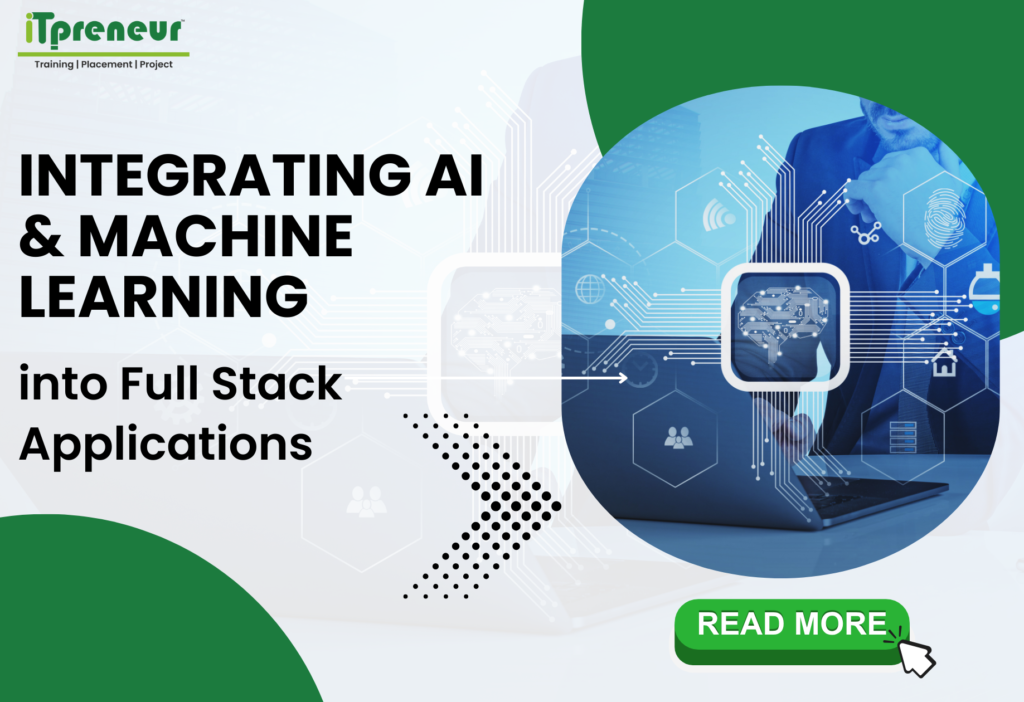
Combining AI & Machine Learning into Full Stack Applications: The Future of Development Technology is developing at a rate never seen before, and Full Stack Development is no different. With companies looking for smarter, automated, and more efficient solutions, Artificial Intelligence (AI) and Machine Learning (ML) have emerged as the drivers of innovation. The combination of AI and ML with Full Stack applications is transforming the way web and mobile applications are developed, making them smarter, more responsive, and extremely user-friendly. Why AI & Machine Learning in Full Stack Development? AI and ML introduce intelligence and automation to applications, and they become more efficient, scalable, and user-centric. Businesses of all industries are using these technologies to deliver improved customer experience, streamline business operations, and better security. Improved User Experience – Recommendation engines, chatbots, and virtual assistants driven by AI enhance engagement. Data-Driven Decision Making – ML algorithms scan enormous quantities of data to predict insights. Automation & Efficiency – AI processes repetitive tasks and minimizes manual intervention. Personalization – AI personalizes app content according to user behavior and choices. Improved Security – AI-based authentication and fraud detection platforms ward off cyber attacks. With all these advantages, AI and ML integration in Full Stack applications is not a choice anymore—it is a necessity. How AI & ML Are Changing Full Stack Development? 1. AI in Frontend Development AI is revolutionizing the frontend by making interfaces more interactive and engaging. Here’s how: ✔ AI Chatbots & Virtual Assistants – AI chatbots are now available on websites and apps, offering real-time support.✔ Voice & Image Recognition – Voice and image-based search features are made possible through AI-powered search capabilities.✔ Personalized UI – AI observes user behavior and dynamically adjusts the UI for a personalized experience. 2. AI in Backend Development The backend is the core of AI-powered applications. Here’s how ML improves it: ✔ Predictive Analytics – AI enables companies to forecast customer tastes, sales patterns, and fraud activities.✔ Intelligent Automation – Process automation through AI-based technology streamlines backend processes, enhancing efficiency.✔ AI-Powered APIs – Developers can implement AI capabilities through APIs such as Google Cloud AI, IBM Watson, or OpenAI. 3. AI in Database & Cloud Integration With cloud computing on the rise, AI is empowering databases to become intelligent: ✔ AI-Optimized Databases – Google BigQuery and other systems leverage AI to process enormous datasets effectively.✔ Cloud-Based AI Services – AWS, Azure, and Google Cloud provide AI-enabled services to improve application performance.✔ Automated Data Processing – AI processes data collection, cleaning, and preparation for analytics automatically. Steps to Integrate AI/ML into Full Stack Applications If you’re a Full Stack Developer, incorporating AI and ML in your skill set can make you stand out. Here’s how you can integrate AI in applications: Step 1: Choose the Right AI & ML Frameworks For backend integration with AI, you require frameworks that facilitate data processing, model training, and automation. Some of the popular frameworks are:✅ TensorFlow.js – For AI integration into JavaScript-based web applications.✅ PyTorch – A strong framework for deep learning.✅ OpenAI GPT – AI-driven text generation models. Step 2: Use AI-Powered APIs for Backend Integration Rather than creating models from the ground up, developers can utilize APIs: Google Cloud AI – Provides NLP, vision, and translation APIs. IBM Watson – Data processing with AI for enterprise use. AWS AI Services – Offers ML-based automation platforms. Step 3: Implement AI-Driven Frontend Features Improve UI/UX by incorporating AI-based features:✔ AI Chatbots – Automate customer interactions with Dialogflow.✔ Personalized Recommendations – Utilize ML to personalize content for users.✔ Voice Assistants – Integrate voice search functionality with AI. Step 4: Optimize Database & Cloud Infrastructure AI boosts data processing and security within cloud environments:✅ AI-Based Security – Restrict cyber threats through AI-powered authentication.✅ Data Optimization – Employ AI for data retrieval and compression.✅ Scalability – AI scales resources dynamically according to need. The Future of AI in Full Stack Development AI and ML are not futuristic ideas anymore—they are driving the future and present of Full Stack development. With increasing demand for AI-integrated applications, developers need to adopt these technologies to remain ahead. Key Takeaways: ✅ AI & ML increase automation, personalization, and efficiency in Full Stack applications.✅ AI-enabled frontend and backend solutions enhance user experience.✅ Cloud-hosted AI tools facilitate easier integration for developers.✅ AI skills are highly sought after, enhancing the value of Full Stack developers. Want to master Full Stack Development with AI & ML? Learn from industry experts at iTpreneur!
How Artificial Intelligence is Enhancing Cybersecurity

With the current digital era, cybersecurity threats are growing at a rate unprecedented in history. Hackers are becoming more sophisticated, and conventional security protocols are usually inadequate to respond to such emerging threats. This is where Artificial Intelligence (AI) comes into play and is changing the face of cybersecurity. The Function of AI in CybersecurityAI is augmenting cybersecurity by offering quicker threat detection, automated response systems, and predictive analytics to avoid cyberattacks. Following are some of the most important ways AI is transforming cybersecurity: 1. Threat Detection and PreventionAI systems are able to scan tremendous amounts of data in real time to identify abnormal patterns and inconsistencies that can be signs of a cyberattack. While conventional security techniques use predefined rules, AI evolves dynamically to identify new threats. 2. Automated Incident ResponseWith AI, organizations can automate responses to cybersecurity threats, reducing response time significantly. AI-driven Security Information and Event Management (SIEM) systems can take immediate action to contain threats before they cause damage. 3. Predictive Analytics for Proactive SecurityAI applies machine learning algorithms to forecast possible cyber attacks based on historical data and prevailing trends. This allows companies to proactively harden their security stance before the attack happens. 4. Improved Phishing and Fraud DetectionPhishing attacks are one of the most prevalent cyber attacks. AI-powered email filtering and analysis tools can identify phishing attempts with high accuracy by examining email content, sender activity, and user behaviour. 5. Insider Threat Behavioural AnalysisAI assists in tracking user activity within an organization to identify any abnormality in activity. This assists in recognizing potential insider threats or compromised accounts before they have the opportunity to do any harm. 6. Enhanced Endpoint SecurityAI improves endpoint security by continuously tracking devices and identifying suspicious behaviour. AI-powered antivirus and endpoint detection and response (EDR) solutions provide real-time malware and other threat protection. The Future of AI in CybersecurityAs cyber threats advance, AI will have an even larger part to play in cybersecurity. Pairing AI with other cutting-edge technologies like blockchain and quantum computing will only build stronger, more resilient security models. AI is by no means a panacea and must be paired with other security techniques, such as robust authentication protocols and ongoing security education for staff. ConclusionArtificial Intelligence is revolutionizing cybersecurity by allowing organizations to identify, stop, and counter cyber threats more efficiently. Organizations that use AI-based cybersecurity solutions can strengthen their defences, lower risks, and remain one step ahead of cybercriminals. With the further development of AI technology, its contribution to cybersecurity will only increase in importance to provide a safe digital environment.
Code, Cloud & Cyber: The 3C Formula for IT Mastery

Code, Cloud & Cyber: The 3C Formula for IT Mastery In today’s digital landscape, staying ahead in the IT industry requires a combination of essential technical skills. Whether you’re an aspiring developer, a cloud enthusiast, or a cybersecurity expert, mastering the 3C Formula – Code, Cloud, & Cyber – is the key to unlocking limitless opportunities in the world of technology. These three pillars form the foundation of modern IT infrastructure and innovation, making them critical for professionals who want to build a strong career. Let’s explore how Code, Cloud, and Cybersecurity are shaping the future of IT and why you should master them today. 1. Code: The Heart of Software Development Why is Coding Important? Code is the backbone of the digital world. Every website, mobile app, and software solution is powered by programming languages like Python, Java, JavaScript, C++, and .NET. As technology advances, businesses require skilled developers to build and maintain their applications efficiently. Key Benefits of Learning to Code: ✅ Develop Scalable Applications – Build powerful web, mobile, and enterprise applications.✅ Enhance Problem-Solving Skills – Coding improves logical thinking and analytical abilities.✅ Automate and Optimize Processes – Write scripts to automate repetitive tasks and increase efficiency.✅ High Demand for Developers – Full-stack, backend, and frontend developers are in huge demand across industries. How to Master Coding? With technology evolving rapidly, software development is one of the most promising career paths. 2. Cloud: The Future of IT Infrastructure Why is Cloud Computing Essential? The world is moving towards cloud-based solutions, making AWS, Microsoft Azure, and Google Cloud the most sought-after platforms. Companies prefer cloud computing for its scalability, cost-effectiveness, and security. Key Benefits of Cloud Computing: ✅ Cost Efficiency – Reduces infrastructure costs for businesses.✅ Scalability – Businesses can scale applications easily as they grow.✅ Remote Accessibility – Cloud services allow data and applications to be accessed anywhere.✅ Job Demand – Cloud computing professionals are in high demand worldwide. How to Master Cloud Computing? With businesses migrating to the cloud, professionals with cloud expertise will always stay ahead in the IT industry. 3. Cyber: Securing the Digital World Why is Cybersecurity Crucial? As technology grows, so do cyber threats. Cybersecurity professionals play a critical role in protecting sensitive information, securing networks, and preventing cyberattacks. Key Benefits of Cybersecurity: ✅ Prevent Data Breaches – Protect organizations from hacking attempts and cyber threats.✅ High-Paying Career – Cybersecurity professionals are among the highest-paid in IT.✅ Ever-Growing Demand – The need for cybersecurity experts is increasing daily.✅ Opportunities in Ethical Hacking – Companies require ethical hackers to identify vulnerabilities. How to Master Cybersecurity? With the increasing number of cyber threats, cybersecurity experts have one of the most in-demand and secure careers in IT. Why Should You Master the 3C Formula? 🚀 High Demand – IT companies are actively hiring professionals with expertise in Coding, Cloud Computing, and Cybersecurity.💰 Lucrative Salaries – These skills offer high-paying job opportunities with career growth.🌍 Global Reach – Businesses worldwide are embracing cloud-based and secure digital solutions.🎯 Future-Proof Career – With AI, blockchain, and IoT growing, these IT skills will always be relevant. By mastering the 3C Formula – Code, Cloud & Cyber, you’ll position yourself as a highly skilled IT professional ready to thrive in a competitive industry. Start Your IT Journey Today! At iTpreneur, we offer industry-focused training in Full Stack Development, Cloud Computing, and Cybersecurity, designed to help you gain hands-on experience and secure a high-paying job. Take the first step toward mastering the future of IT! 🚀
Code Like a Pro: Master Java, Python & Everything in Between
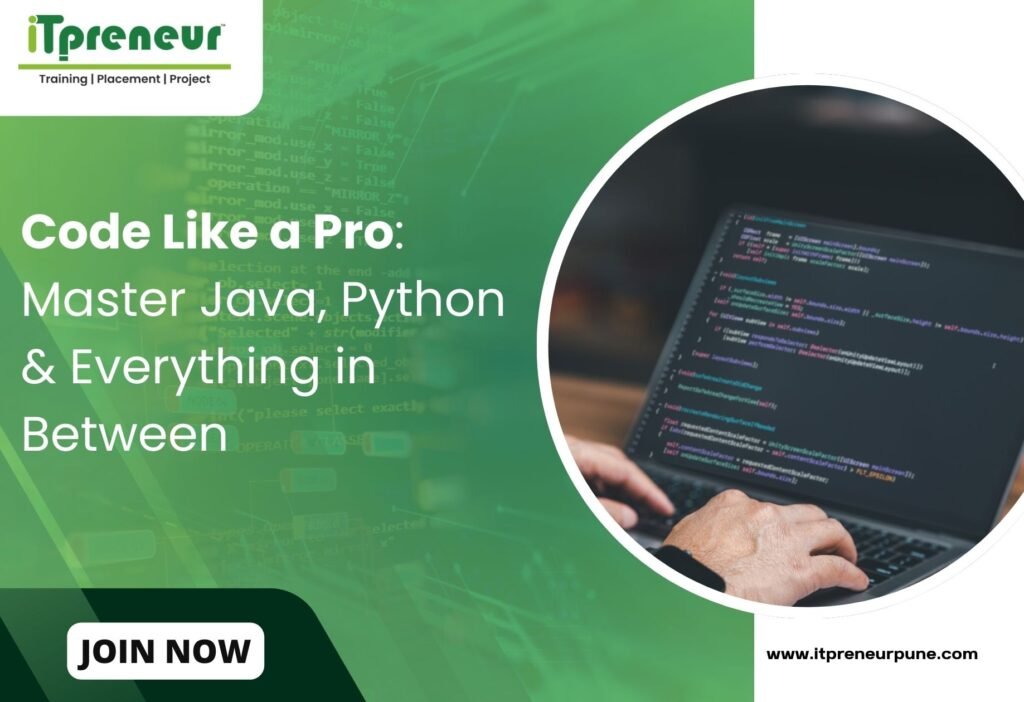
Introduction Coding is no longer just a skill—it’s a superpower! Whether you’re diving into Java, exploring Python, or juggling multiple languages, mastering programming can unlock limitless opportunities. In this blog, we’ll guide you on how to code like a pro, improve your efficiency, and level up your skills in Java, Python, and more! Why Java & Python? Java and Python are two of the most popular programming languages, each with unique strengths: Learning both gives you the flexibility to work on diverse projects and expand your career opportunities. Companies worldwide rely on these languages for robust and scalable applications, making them essential for every developer. Steps to Master Java, Python & More 1. Build Strong Fundamentals Mastering any programming language starts with understanding the basics. These include: A strong foundation will help you understand advanced topics more easily and write clean, efficient, and maintainable code. 2. Practice Through Projects The best way to learn programming is by building real-world applications. Some project ideas include: Java Projects Python Projects Working on projects helps solidify your learning and gives you a portfolio to showcase to potential employers. 3. Master Development Tools Professional developers use various tools to enhance their coding efficiency. Some essential tools include: Having expertise in these tools makes your development process faster and more professional. 4. Contribute to Open Source One of the best ways to grow as a developer is by contributing to open-source projects. Benefits include: To get started, visit platforms like GitHub, GitLab, and Bitbucket, explore repositories, and start contributing to projects that interest you. 5. Stay Updated & Keep Learning The tech industry evolves rapidly, and staying updated is crucial. Here’s how you can keep learning: Continuous learning is the key to staying ahead in the competitive field of programming. Beyond Java & Python: Expanding Your Skillset Once you’ve mastered Java and Python, consider expanding your expertise with additional technologies: The more skills you acquire, the more versatile you become in the tech industry. Best Practices to Code Like a Pro To truly code like a pro, follow these best practices: 1. Write Clean Code 2. Follow Design Patterns 3. Use Documentation & Comments Wisely 4. Test Your Code 5. Optimize for Performance By incorporating these best practices, you’ll write better, cleaner, and more efficient code. Conclusion Becoming a professional coder isn’t just about memorizing syntax—it’s about problem-solving, hands-on practice, and continuous learning. Whether you’re mastering Java, Python, or expanding your knowledge into other technologies, staying consistent and curious will set you apart. Key Takeaways: Now it’s your turn! What’s your favorite programming language, and how do you practice coding? Share your thoughts in the comments!
How to Build Your First Full Stack Web Application

Introduction Building a full stack web application can be an exciting journey, combining front-end and back-end technologies to create a fully functional product. Whether you are a beginner or an aspiring developer, this guide will walk you through the essential steps to build your first full stack web application. Step 1: Choose Your Tech Stack Before you start coding, selecting the right technologies for your application is crucial. Here’s a popular full stack choice: Front-End (Client-Side) Back-End (Server-Side) Database Version Control & Deployment Step 2: Set Up Your Development Environment Step 3: Create the Front-End Step 4: Build the Back-End Step 5: Connect the Database Step 6: Implement API Routes Create routes to handle CRUD (Create, Read, Update, Delete) operations: Step 7: Connect Front-End with Back-End Step 8: Deploy Your Application Conclusion Building a full stack web application involves integrating front-end, back-end, and database technologies. By following these steps, you’ll gain hands-on experience in designing, developing, and deploying a functional web app. Keep experimenting and refining your skills to become a proficient full stack developer! Are you ready to build your career in Full Stack Development? Join iTpreneur for expert training and 100% job placement assistance! 🚀 📞 Call us: 8237002020 | 8087423030🌐 Visit: www.itpreneurpune.com
The Future of Flutter: What to Expect in 2025 and Beyond

Flutter has been one of the most sought-after cross-platform frameworks to date, enabling developers to create high-performance apps for mobile, web, desktop, and even embedded platforms. As we enter 2025, things are looking up for Flutter, with some awesome developments in the pipeline. Let’s see what the future holds for Flutter and how it will transform the world of app development.
Why Every IT Professional Needs a LinkedIn Profile??

In today’s digital era, where networking and online presence are crucial, LinkedIn has become a game-changer for IT professionals. Whether you’re a software developer, cybersecurity expert, data analyst, or IT manager, having a strong LinkedIn profile is no longer optional – it’s a necessity. ConclusionIn today’s high-speed IT environment, a LinkedIn presence is not a nicety but a necessity—a critical career asset. Whether you’re looking to find a new job, expand your network, or become a thought leader in your field, LinkedIn can assist you in reaching your career objectives.
Hack Your Future: Unlock IT Success with the Right Skills

In today’s fast-paced digital era, the IT industry is evolving at an unprecedented rate. Success in this dynamic field is no longer solely dependent on having a degree—it requires mastering the right skills, staying ahead of technological advancements, and adapting to industry demands. If you aspire to build a successful career in IT, now is the time to equip yourself with the essential skills that truly matter. 1. Understanding the IT Landscape: The Need for Adaptability The IT sector is a constantly shifting ecosystem where new technologies emerge, and old ones become obsolete. Whether you are an aspiring developer, cybersecurity expert, or cloud architect, the ability to adapt and continuously learn is your greatest asset. Key Insight: IT professionals who embrace change and proactively upskill themselves have a significant edge over those who rely solely on traditional education. 2. Mastering Core Technical Skills: The Building Blocks of IT Success To thrive in IT, proficiency in fundamental technical skills is essential. The core competencies that can set you apart include: 3. Soft Skills: The Unsung Heroes of IT Success While technical expertise is crucial, it is soft skills that differentiate a good IT professional from a great one. Companies seek individuals who can: 4. Certifications and Continuous Learning: Staying Ahead of the Curve In the IT industry, learning never stops. Certifications provide a competitive advantage and validate expertise. Some of the most recognized IT certifications include: Beyond certifications, staying updated through technology blogs, online courses, workshops, and industry conferences ensures long-term relevance in this competitive industry. 5. Real-World Experience: Bridging the Gap Between Theory and Practice A common mistake aspiring IT professionals make is focusing solely on theoretical knowledge without applying it in real-world scenarios. Practical experience is key, and it can be gained through: 6. Networking: The Shortcut to Career Growth In the IT industry, opportunities often come through referrals and professional connections. Expanding one’s network is crucial for career advancement. Key strategies include: 7. Embracing Innovation: The Future of IT Careers With emerging technologies such as blockchain, quantum computing, the Internet of Things (IoT), and edge computing transforming the industry, those who stay curious and embrace innovation will be the ones leading the future. IT success is no longer just about coding—it is about problem-solving, adapting, and leveraging technology to create a lasting impact. Conclusion: Take Charge of Your IT Future Success in IT is not just about securing a job—it is about crafting a career path that aligns with one’s strengths and aspirations. The key to unlocking IT success lies in: The future belongs to those who are proactive, skilled, and ready to innovate. Now is the time to take charge, enhance your expertise, and unlock your IT success. The opportunities are endless—seize them with confidence and determination.
IT Job Market Trends: What Recruiters Are Looking for in 2024

IT Job Market Trends: What Recruiters Are Looking for in 2024 IT Job Market Trends: What Recruiters Are Looking for in 2025 The IT job market is evolving rapidly, and as we enter 2025, recruiters are on the lookout for professionals who can adapt to technological advancements, industry shifts, and new skill demands. Whether you are a fresher or an experienced professional, staying ahead of these trends will give you a competitive edge in securing high-paying jobs in the IT sector. 1. High Demand for AI & Machine Learning Professionals Artificial Intelligence (AI) and Machine Learning (ML) continue to dominate the IT landscape. Companies are increasingly leveraging AI for automation, data analysis, and customer experience enhancement. Recruiters are actively seeking candidates with expertise in: 2. Cybersecurity: A Top Priority With the rise of cyber threats, organizations are investing heavily in cybersecurity. Skilled cybersecurity professionals are in high demand to protect sensitive data and prevent breaches. Key skills that recruiters seek include: 3. Cloud Computing and DevOps Expertise As businesses continue shifting towards cloud-based infrastructures, recruiters are on the lookout for cloud specialists and DevOps engineers. Desired skills include: 4. Full-Stack Development Continues to Thrive The demand for full-stack developers remains strong, as companies look for professionals who can handle both front-end and back-end development. The key technologies in demand include: 5. Data Science & Analytics: The Power of Decision-Making Companies rely on data-driven insights to make strategic business decisions, increasing the demand for data scientists and analysts. Recruiters prioritize candidates with expertise in: 6. The Rise of Blockchain & Web3 Technologies Blockchain is expanding beyond cryptocurrency, with industries using it for smart contracts, secure transactions, and decentralized applications. Recruiters are looking for: 7. Soft Skills Are More Important Than Ever Apart from technical expertise, recruiters in 2025 are emphasizing soft skills such as: How to Stay Ahead in the 2025 IT Job Market Conclusion The IT job market in 2025 will be driven by advanced technologies, security concerns, and data-driven decision-making. To stay competitive, job seekers must focus on acquiring in-demand technical skills while also improving their soft skills. Whether you’re an aspiring developer, a data scientist, or a cybersecurity expert, staying ahead of these trends will position you for success in the evolving IT industry. Are you looking to upskill and land your dream IT job? Explore our latest IT training programs with 100% job guarantee at iTpreneur! 🚀